Global Mining Tech 50: The top 50 global mining/metals tech players
- 14 April 2026

The 50 entities best positioned to shape mining’s technology-led response to major technical, social, environmental and geopolitical challenges over the next decade generated about US$6.8 billion of sales to the industry in 2025. That might not sound like much.
But the top 50 global mining and metals technology suppliers have collectively lifted sales into the market by 73.5% over the past five years – at a fair 11.6% (CAGR) clip – showing that miners are indeed spending more on tech.
And, in line with market commentary from the CEOs of leading companies in the space, this investment is accelerating.
Software, sensors and analytics platforms are driving most of the current expansion.
However, the industry is only scratching the surface of key growth markets for tech companies and those that have built serious tech arms. The growth areas range from machine automation and control – new Komatsu partner Applied Intuition suggests a circa $1.6 billion mining-vehicle autonomy market can expand eightfold by 2031 – to wireless rock fragmentation and “orebody intelligence” technologies. “We are building [markets] that didn’t exist five years back. The potential is massive,” says Orica CEO Sanjeev Gandhi.
And if mining’s increased appetite for technology and stronger financial flows into the sector are the fuel propelling mining and metals tech into a new era, AI could be what really ignites sector expansion.
“Artificial intelligence is increasingly shaping how BHP operates,” the world’s biggest miner said at the start of 2026. The company’s chief technical officer Johan van Jaarsveld said: “AI is no longer a future concept for BHP. It is increasingly part of how we run our operations. AI is helping us understand our operations in new ways and act earlier, with greater confidence. What excites us is the scale of opportunity ahead.”
While AI will continue to be “baked into” mining tech, as one Australian expert puts it, there is no doubt the value it helps to unlock can be captured in new and perhaps different supplier-miner compacts.
Technology-led contracts focused on mobile fleet and orebody/waste management – combining smart machines and even smarter enterprise-level platforms – fixed asset management, and integrated versions of these systems, shape as gamechangers for major suppliers of tech, software and hardware, and even traditional contract services.
Smarter, more reliable and better utilised machines can underpin new performance-based deals that align technology company rewards with increased value being generated, however that is measured.
Similar to conventional fixed-asset engineering, procurement and management contracts, these technology-centric engagements could also see several suppliers form alliances to enable large-scale delivery of projects. Already, leading players in the nascent mining and metals technology space – including Orica, IMDEX, Seequent (Bentley Systems), Epiroc and ABB – are working more closely together to accelerate delivery of integrated hardware-and-digital platforms and systems.
Decades of dialogue around the industry’s (rising) capital intensity being a non-negotiable is finally shifting. The “more, more, more” mantra is being replaced, in some quarters, by a less-is-more focus. Paul House, CEO of Western Australia-based IMDEX, says the industry’s approach to most of its problems – labour, escalating input costs and deeper, more complex orebodies that are harder to access – has been to buy a bigger pick, shovel or wheelbarrow.
“The traditional response – more drilling, more equipment – no longer delivers the returns it once did,” he says. “What’s needed now is a shift from volume-based productivity to intelligence-based productivity.
“That shift also changes how we think about time. In mining, information gathered early in the value chain behaves like a financial option: it gives you the right, but not the obligation, to make smarter decisions later. By front-loading key data acquisition – rock properties, structure, chemistry – you effectively purchase a call option on knowledge.
“If conditions change, that same data acts as a put option, protecting against downside risk.
“Better early information widens your future choices. Poor or late data narrows them. The companies that learn to treat data this way will redefine what productivity really means.”
The time for hockey-stick growth in mining and metals tech-sector sales is close, which is great news for the companies listed below.
Top 50 players: the mix
Mining Beacon’s inaugural listing of the world’s top 50 global mining and metals tech enterprises is based on 2025 mining and metals tech sales revenues only, not overall equipment, service and other sales. A number of the leading entities are divisions or arms of corporations – such as Hexagon, Epiroc and Komatsu – while the biggest player in the space, ABB, attributes a percentage of its vast annual revenues to the mining and metals vertical and the nature of these revenues allows a tech-centric calculation.
Companies such as Siemens and SAP are not included because their accounting departments do not consider mining/metals a material standalone income stream.
The top 50 features a mix of familiar industrial tech names such as ABB, Rockwell Automation, Schneider Electric, Honeywell and Yokogawa, fast-growing tech-focused newcomers and traditional mining suppliers that have been among the top consolidators of a highly fragmented mining and metals tech universe over the past decade. It also has non-mining tech companies that have built significant mining/metals arms via acquisition.
The latter list is headed by Hexagon, Bentley Systems, Constellation Software and Dassault Systemes.
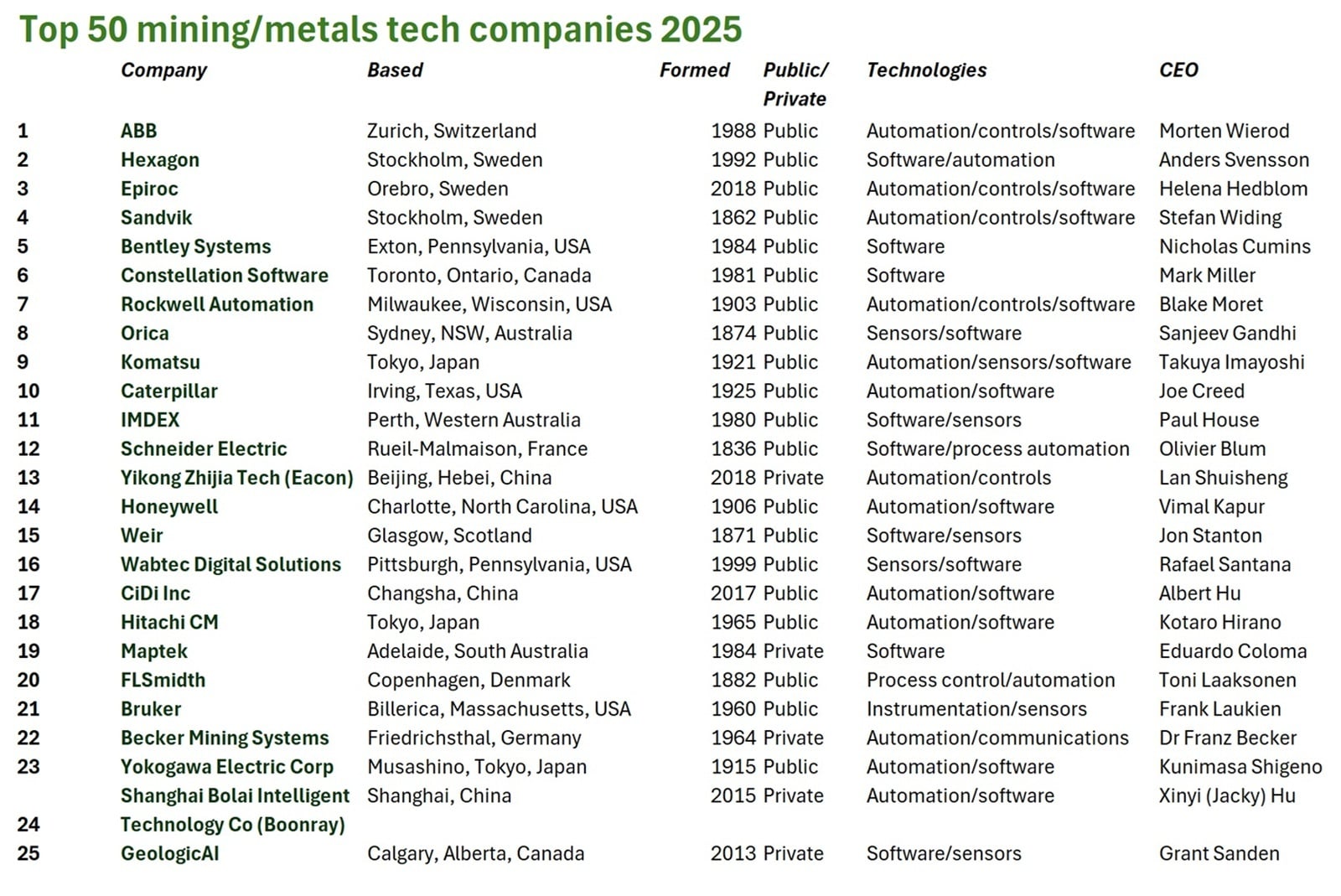
“[Hexagon Mining] is a conglomerate of acquisitions,” 30-year sector veteran and senior division director Jason Pearce said at a Hexagon Mining event in Australia. “We see technology transforming other industries [Industry 4.0]. We’ve got all the technology now in mining but we’re not using it yet.”
Constellation has been the most prolific buyer of mining software firms over the past five years. Going back even further it has swallowed up more than 30 of them since 2011. CEO of group mining flagbearer Datamine, John Bailey, previously told Mining Beacon miners were probably spending more than $1 billion a year on software. “Our view is mining customers will continue to expand their spend on mining technology at double digit growth rates,” he said.
Bentley made the biggest mining-tech acquisition of the past five years with its $1 billion-plus purchase of New Zealand-based Seequent in 2021. Seequent has been a standout performer for New York-listed Bentley. Seequent’s original Leapfrog geo-modelling software has been a major driver but CEO Graham Grant told Mining Beacon the company’s relatively new Evo cloud enterprise platform could be more emblematic of its future.

“Our vision for Seequent Evo is to unite disconnected teams and data, creating an open platform that is also the foundation for new mining innovations,” he said. “If Evo being open is something that's adopted and accepted then by its very nature it becomes a flywheel for new innovation because it connects [those disconnected] teams to their very own data and gives them a pathway to connect into [different organisational] workflows and build highly innovative new approaches.
“That’s just not possible under the industry’s old software paradigm. If you look at the history of [mining tech companies] you will see some struggling along for years. Look how long it took Leapfrog to become commonplace in the market. It was more than 10 years.
“That’s too slow. We just cannot innovate at that speed.”
The period has seen c$15 billion of M&A and financing, which is unprecedented for the space.
Major mining original equipment manufacturers Epiroc, Sandvik, Komatsu, Caterpillar, Weir and Hitachi Construction Machinery have also been lead participants in the mining-tech M&A surge in the past five years.
Last year alone London-listed Weir shelled out $800 million and US-based Caterpillar $735 million for Australian mining software firms, Micromine and RPMGlobal, respectively. Pittsburgh-headquartered Wabtec Corporation paid $1.78 billion for Evident Scientific Inspection Technologies to bolster its digital rail, mining and industrial maintenance business.
Epiroc, Sandvik and Komatsu have similarly been very busy buying up software, sensor, communication and simulation tech. Epiroc CEO Helena Hedblom says a $230 million 2025 order for autonomous electric mine drills from an Australian iron ore major is “a clear signal that automation and electrification have moved from pilot projects to implementation at full industrial scale” in the industry.

Hard revenue and earnings numbers also clearly signal to investors that material investments in M&A and tech R&D can generate adequate returns. Investors have been sceptical in the past – justifiably given the general paucity of returns and the related absence of supplier transparency.
Australian Securities Exchange-listed Orica is among a handful of companies providing investors with clear indications of what they might get from c$800 million of outlay on mining tech (so far) and formation of a $190 million-a-year mining digital business. “Growth in this business is important as we see it justifying a higher multiple going forward as it increases in importance,” US investment bank Morgan Stanley said.
Epiroc’s Hedblom has said the company’s frenetic acquisition pace since its 2018 Stockholm Stock Exchange listing as Epiroc, including 13 mining tech deals since 2021, was aimed at future-proofing the business.

“Our business is not as transactional as it was maybe 10 years ago,” she said. “It’s much more a partnership together with our customers, where we are together bringing the best out when it comes to productivity and sustainability. We continue to add more partners to this system because this is how we gain speed. We are a strong believer that the fastest player will win.
“I strongly believe that partnership is the new leadership. We also gain speed by doing acquisitions. We have a very solid acquisition model. That’s very much to create the next horizon of growth. What is it actually that customers [will be] prepared to pay for maybe five years from now? We see that we are growing our customer share by having these technologies. We also see that we get higher aftermarket penetration when we have more advanced machines out there.”
Epiroc’s market capitalisation has climbed by more than 20% in the past five years to about $31 billion.
Newcomers
Mining is seeing names emerging with promises to disrupt the industry. The top 50 list has Chrysos Corporation, Fleet Space Technologies and Ideon. Outside of this group there are the likes of Mariana Minerals and KoBold Metals.
The biggest change, though, is coming from China.
There are five Chinese-based companies in the top 50 (versus 10 in Australia, nine in the USA, five in Canada and four in Japan).
Their annual revenues have reportedly been rising fast. They have been raising equity capital via private channels as well as receptive Hong Kong and Shanghai public markets.
Chinese mining and metals companies have correspondingly become fixtures on the world’s league table of industry leaders. They have exposure to all metals and have built deep domestic and international project pipelines, which arguably adds a different dimension to the addressable markets Chinese tech companies are presenting to investors.
Changsha-based CiDi (Changsha Intelligent Driving Research Institute), which raised $167 million via a Hong Kong listing in December last year, claimed to have doubled its annual revenue run rate in the first six months of 2025. It promoted a $85 million order book for autonomous mine trucks and systems in the middle of 2025.
In its 2026 HKSE prospectus, Shanghai Boonray Intelligent Technology Co (Boonray) quotes Shanghai-based China Insights Consultancy which says an estimated $275 million of “autonomous mining truck solutions” sold in China in 2024 could grow to $550 million by 2030. “In terms of shipment volume the market size of China’s autonomous mining truck solutions reached 1400 units in 2024 and is expected to grow to 16,300 units by 2030,” CIC said.
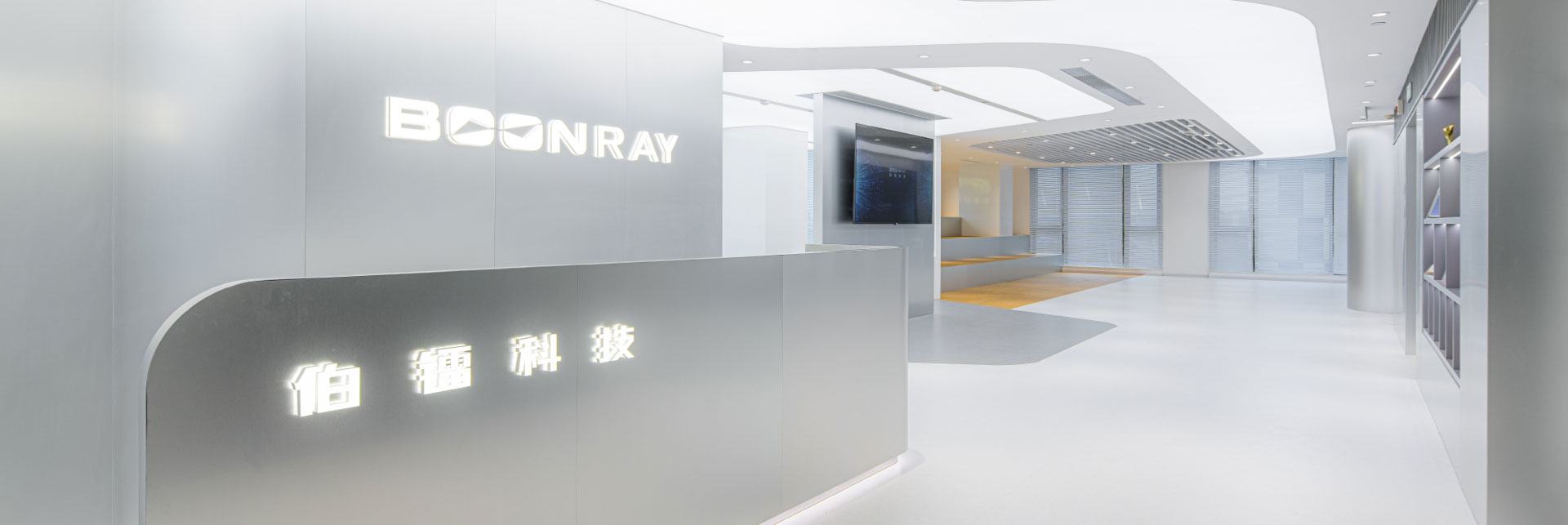
Boonray says autonomous mining truck solutions refer to “a series of products and services centred on mining transport vehicles with L4 autonomous driving capabilities, enabling autonomous driving and precise loading and unloading in the transportation link of mining areas without human intervention”.
“The mining industry has become one of the earliest sectors in China to achieve large-scale commercial implementation of autonomous driving,” it says.
Chinese EV and battery maker BYD backed a recent $165 million Boonray private funding round.
Veteran Western mining technology leader, Andrew Pyne, who now heads Sandvik’s mining software unit, Deswik, says he expects to see a new generation of technology providers enter the mining industry and expand the applicability of automation in mining “over the new few years”.
“These new technologies will be leveraging emerging level-five fully automated capabilities to augment the tremendous value already delivered by the OEM AHS solutions,” Pyne says.
He says a golden two decades (or more) in which mining rode a wave of global industrialisation is giving way to resource nationalism and supply chain fragmentation. In this context, a race to build sovereign capability up-and-downstream of vital industrial complexes now clearly encompasses mining and metals technology that can create and sustain competitive advantage.
“There is a mine of the future in China that’s already zero-entry automated,” Pyne notes. “It’s fully automated coal mining and it’s fully electric [with] battery electric vehicles where the battery gets changed out faster than a fuelling cycle on a haul truck.”
“This disconnect between ambition and execution is of course not unique to mining, but the stakes are getting higher here”
On mining’s broader “digital challenge”, Pyne says technology adoption is “one of the most critical areas of focus for mining operations, specifically to operationalise their technology usage”.
“Many mining companies experiment with tech, spending a lot of time and effort trying to make things work but often beyond a proof-of-concept phase these potential solutions aren’t introduced to drive any operational change or impact,” he says.
“This disconnect between ambition and execution is of course not unique to mining, but the stakes are getting higher here.
“With permitting timelines stretching into decades, risks growing and capital costs escalating, the industry cannot afford to lag in innovation.
“The question is no longer whether to transform, but how and how fast.”
In the US, the country most aggressively trying to claw back some of the material supply chain supremacy ceded to China over the past 30 years, industry heavyweights such as Caterpillar and Komatsu have teamed with Silicon Valley tech-cos to accelerate the merging of AI and mobile autonomy in resource extraction.
Some don’t think that is going to move the dial fast enough.
Ex-Tesla battery minerals supply chain manager Turner Caldwell, CEO of Silicon Valley start-up Mariana Minerals, says big Western mining companies “look exactly like Ford and GM before Tesla”.
“They look a lot like NASA before SpaceX. They look a lot like the big defence primes before Anduril,” Caldwell says.

“Over the past generation Western companies have ceded control of the minerals supply chain to aggressive, innovative Chinese companies that now dominate the industry. The West faces a shrinking labour pool, a difficult regulatory environment and a challenging-to-extract resource base, leaving no clear path to delivering the metals that underpin the modern economy.
“Chinese minerals companies are growing voraciously: building faster, commissioning faster and leveraging each project’s learnings into a larger skilled labour pool, steadily cutting execution time and cost from one project to the next. The result of this concerted effort and differentiated execution capability is dominance across the critical minerals value chain.”
Caldwell describes Mariana, backed by Andreessen Horowitz and Bill Gates’ Breakthrough Energy, as a “vertically integrated minerals project developer and operator, designed to be software-first from day one, integrating modern machine learning and artificial intelligence at every level of our operations”.
An early test of its build-own-operate-innovate model of resource delivery will be seen as it tries to grow copper production at a small-scale site in Utah.
“Just as Tesla reimagined the automotive industry, SpaceX revolutionised space exploration and Anduril is reshaping defence, Mariana is bringing minerals production – mining and refining – into the 21st century,” Caldwell says.
Download the full report here.